

Remembering the Forgotten: Read Their Stories
While information is woefully lacking, the stories of who lays below these gravestones needs to be unearthed and told. We hope to uncover their stories and share them as a memorial and reminder that all children should be treated with dignity.
Help us research the House of Reformation and similar lost burial grounds.
Do you know of someone who was sent to the House of Reformation or died there between 1872 and 1939? Do you know of other burial grounds for incarcerated children in your community? Help us tell their stories. Contact us at CenterForYouthJustice@georgetown.edu.
Charles Salisbury and John Hall
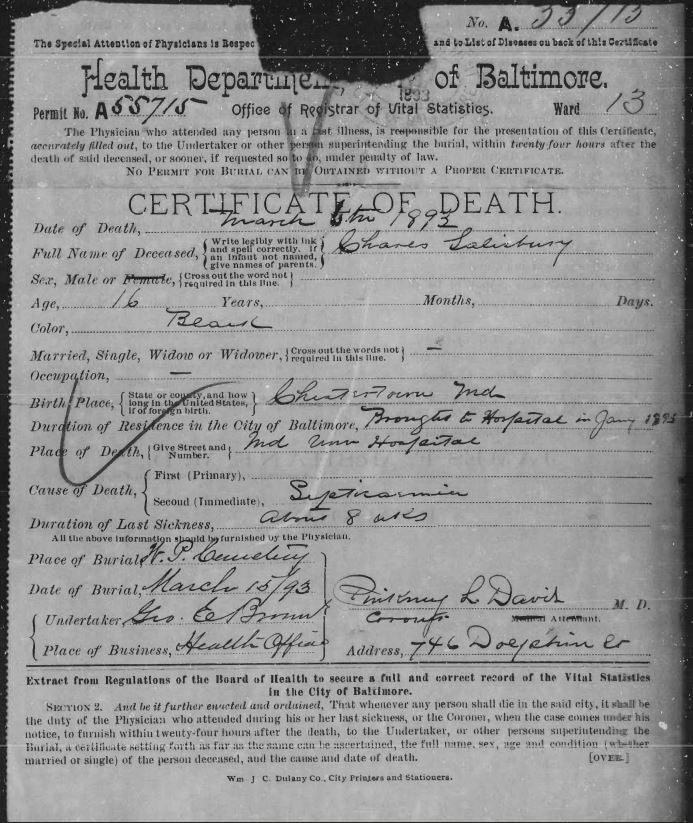
Charles Salisbury, 16, and John Hall, 17, suffered from severe frostbite in their feet after working without shoes in the winter of 1893, according to an account given by Hall to local newspapers. Instead of being treated, the boys were locked in a cell for days with no bed and only a thin blanket to guard against the cold as the pain in their feet worsened, Hall said.
Both were hospitalized and had their legs amputated. Hall survived, but Salisbury died.
A grand jury concluded that neglect by House of Reformation officials led to his death. But the death certificate reduced the cause to a single phrase: blood poisoning. During the grand jury proceeding, Hall had to be carried into the grand jury room due to his legs having been amputated.
(Source: Washington Post 9/22/25)
James Black, William Brown, James Dixson, John Robertson, George Williams, and Matthew Bloe
By the House of Reformation’s third year, three boys had died in a tuberculosis outbreak, records show. But the earliest names documented were from the 1877 annual report, when six more boys died: James Black, William Brown, James Dixson, John Robertson, George Williams and Matthew Bloe.
Their ages were not given. Their reported causes of death ranged from “lockjaw” to scarlet fever. Illnesses like pneumonia and typhoid fever appear frequently in the records of dozens of boys who died at the facility.
But child welfare advocates would eventually question the integrity of the institution’s cause of death determinations, including Bloe, who House of Reformation officials said died of “spinal meningitis.”
Just before he died, a sickly Bloe told a cook and a steward at the hospital that his teacher had struck him in the back with a hatchet, according to a Baltimore Sun story at the time. The teacher admitted to “playing” with the boy and was fired from the facility. But no coroner examined Bloe’s body before it was buried, according to the Sun, and a postmortem report said no injuries were found.
(Source: Washington Post 9/22/25)
Aubrey Brunson
In 1934, Aubrey Brunson, 21, was shot and wounded by a White guard after he refused to get in line for food, according to a report in the Afro-American. Weeks later, Harry Brown, another boy there, told the newspaper in an article headlined “Maryland’s Hell Hole” that officials were hiding some deaths. They weren’t embalming bodies, he said, or notifying parents when boys died.
On one occasion, Brown said, a child’s parents were told that their son had run away, records show, something that House of Reformation staff commonly reported about missing boys. But, Brown told the newspaper, “the truth is that I had helped bury that boy just the night before.”
(Sources: Washington Post 9/22/25 and Afro-American newspaper: Cheltenham: Maryland’s Hell Hole 9/29/34 (Maryland Historical Trust)).
Scott Robinson
In 1892, it was reported that a 20 yr old youth named Scott Robinson was allegedly stabbed to death by another boy at the facility during an altercation on the playground. Scott had been incarcerated in the House of Reformation for being “incorrigible” in 1885 at the age of 13, and had remained incarcerated in the facility for seven years until his death at the age of 20.
(Source: Info on Find a Grave)