

Transforming Juvenile Probation

The Transforming Juvenile Probation Certificate Program is designed to guide and support teams from state and local jurisdictions—including probation leadership, judges, attorneys, and other key stakeholders—to fundamentally transform their system-wide approach to probation.
Over the past two decades, youth justice systems in the United States have seen significant advancements—youth arrest rates have dropped to historical lows, and incarceration rates have been halved. Despite these gains, however, recidivism rates remain unacceptably high for youth under system supervision, and resources invested in supervision and services have not consistently produced improved outcomes.
A key reason that jurisdictions struggle to improve outcomes for young people in the youth justice system may be that the most common disposition—probation—remains largely unexamined and unchanged. Youth justice systems cannot expect to improve public safety and youth outcomes, employ resources more efficiently, or reduce the disparate treatment of youth of color by simply making minor adjustments to current approaches.
To address this challenge, the Center for Youth Justice offers the Transforming Juvenile Probation Certificate Program, developed in partnership with and support from Annie E. Casey Foundation (Casey). The goal of the Certificate Program is to guide teams from state and local jurisdictions—including probation leadership, judges, attorneys, and other key stakeholders—to fundamentally transform their system-wide approach to probation. Through this opportunity and continued partnerships with selected jurisdictions, CYJ and Casey also aim to support innovative leaders who are committed to promoting national juvenile probation transformation.
The curricula for the program are based on the principles and practices outlined in the Casey Foundation publication, Transforming Juvenile Probation: A Vision for Getting It Right, the CYJ and CSG Justice Center publication, Transforming Juvenile Justice Systems to Improve Public Safety and Youth Outcomes, the American Probation and Parole Association’s 10 Core Principles of Juvenile Probation, and Casey’s free Juvenile Probation Transformation Training Series. Together, these resources offer a shared vision and practical guidance for redesigning probation to promote youth success. The Certificate Program extends the opportunity for state and local jurisdictions to convene for an intensive week-long training—followed by extensive post-program technical assistance—to begin transforming juvenile probation in their jurisdictions.
Fifteen jurisdictions from across the U.S. participated in the programs in 2019 and 2024, currently leading efforts to transform their respective systems. The Certificate Program builds on Casey’s 30 years of experience with the (JDAI) and decades of studying probation with researchers, practitioners, youth, families, and pilot probation transformation sites
Key Dates and Location
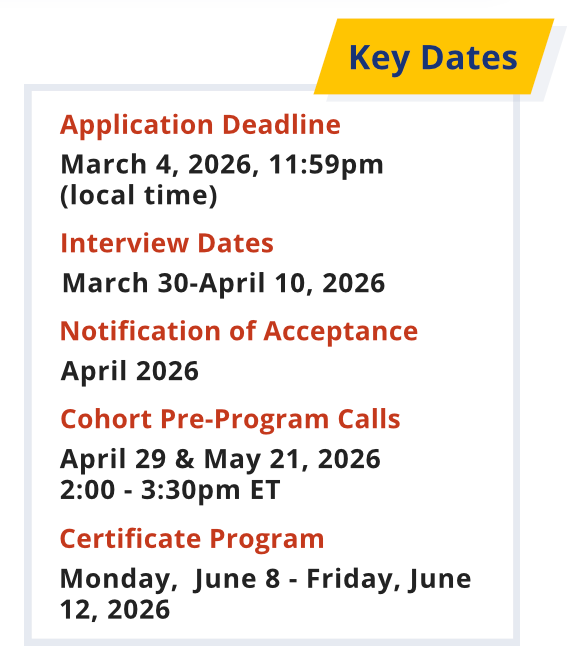
The Transforming Juvenile Probation Certificate Program will be held on June 8-12, 2026 at Georgetown University’s Capitol Campus in Washington, D.C. The program begins in the morning of June 8 and concludes mid-day on Friday, June 12 . Participants must commit to attending the full program in-person in order to receive the CYJ Certificate. Additional details will be provided upon acceptance.
Program Curriculum
The Transforming Juvenile Probation Certificate Program is an intensive and immersive training experience. It is designed to support jurisdictions that seek to fundamentally transform their approach to probation in order to improve public safety and outcomes for young people in the youth justice system. Participating teams will receive instructions from researchers, policymakers, and practitioners, as well as guidance from CYJ and Casey, to develop and implement a Capstone Project advancing system-wide reform in their jurisdiction through advancing probation practices.
The program curriculum will cover the following themes:
Capstone Project and Post-Program Technical Assistance
As a critical part of the Certificate Program, teams will develop a Capstone Project laying out the transformational plan for their jurisdiction. The Capstone Project is a detailed, concrete, strategic action plan and a blueprint for the broader transformative local system changes that each team will seek to effectuate, serving as a starting point for a multi-year work rather than a one-time deliverable. It will help jurisdictions build a roadmap that can sustain momentum beyond individual leaders and staffing changes. Each team will be assigned a Technical Assistance Team Lead, supplied by the Casey Foundation, who will support teams in designing, implementing, and evaluating their Capstone Project. More information on this post-program TA can be found in the next section.
During and after the Capstone period, teams will receive additional TA, courtesy of the Casey Foundation, to support the implementation of their Capstone Project and ongoing probation transformation work. This additional engagement will include an in-depth examination of current organizational structures and practices, establishing common system metrics with regard to probation outcomes and processes, and broadening and deepening stakeholder engagement in the effort to transform juvenile probation.
More information about the Capstone Project and Post-Program Technical Assistance can be found in the 2026 TJP Application Packet.
The Program in Action: New Hampshire’s Probation Transformation
Learn more about the impressive efforts underway in New Hampshire as they fundamentally transform their probation and diversion systems.
Video link: https://youtu.be/W65JnnJJ1sY
After participating in the 2019 Transforming Juvenile Probation Certificate Program, New Hampshire’s capstone project worked to make probation a purposeful intervention and practice that targeted youth who pose significant risk for serious re-offending through individualized, positive, pro-social approaches.
Program Cost
Through the generous support of the Annie E. Casey Foundation, participant’s tuition for the Certificate Program and a minimum of one year of distance and on-site consultation and implementation TA are provided at no cost. Teams will be responsible, however, for covering their travel expenses for the Certificate Program, including airfare, local transportation, and meals and incidentals (outside of breakfast and lunch provided during the program).
Application Guidelines
Applications will be accepted until 11:59 p.m. on Wednesday, March 4, 2026 (in the applicant’s local time zone).
Please download the full Application Packet below. Applications must be completed online on the Application Portal (found here, and below).
- Each team member must complete and submit an application online. If you are a team member applying as part of a team, but you are NOT the designated team liaison, please complete Part 1 of the application.
- In addition, a designated team liaison must submit a response to the Background Questions on behalf of the full team.


Selection Criteria
A total of five multi-disciplinary teams will be selected for participation in the Certificate Program. The teams selected will represent both geographic and demographic diversity and are expected to have representation from a local jurisdiction. In this regard, state-level teams, whether from a state or locally-run probation system, should include a pilot local jurisdiction on their team. Local teams applying from a state-run probation system are expected to have state-level participation and approval for selection. More information about the selection criteria can be found in the 2026 TJP Application Packet above.
Questions?
Please don’t hesitate to contact Amber Farn (amber.farn@georgetown.edu) if you have any questions about the program or the application process.
Participating in the Transforming Juvenile Justice Cohort with the Annie E. Casey Foundation was an incredible opportunity for our community. The cohort deepened our understanding of the history of youth justice and the national vision for transformation. Through a combination of trainings and learning alongside others in the cohort, we were exposed to different challenges and solutions that pushed us to ask tough questions and identify approaches that worked for us in Riverside County through cross-system collaboration.
This experience was a true catalyst for shifting our culture and strengthening how we implemented our strategy. The technical assistance we received following the initial training has been invaluable, and we would not have made the progress we have today without the leadership, guidance, and ongoing support of the Annie E. Casey Foundation consultants and team.
Ramon Ramos, CEO, The Exception
More Information

As part of the Certificate Program, participants are required to develop and implement a Capstone Project during the twelve-month period following the completion of their Certificate Program session.

The primary goal of all of our Certificate Programs is not simply knowledge, but effective implementation in a local reform effort. We study “what works” and collaborate with leaders to bridge the gap between theory and practice.